
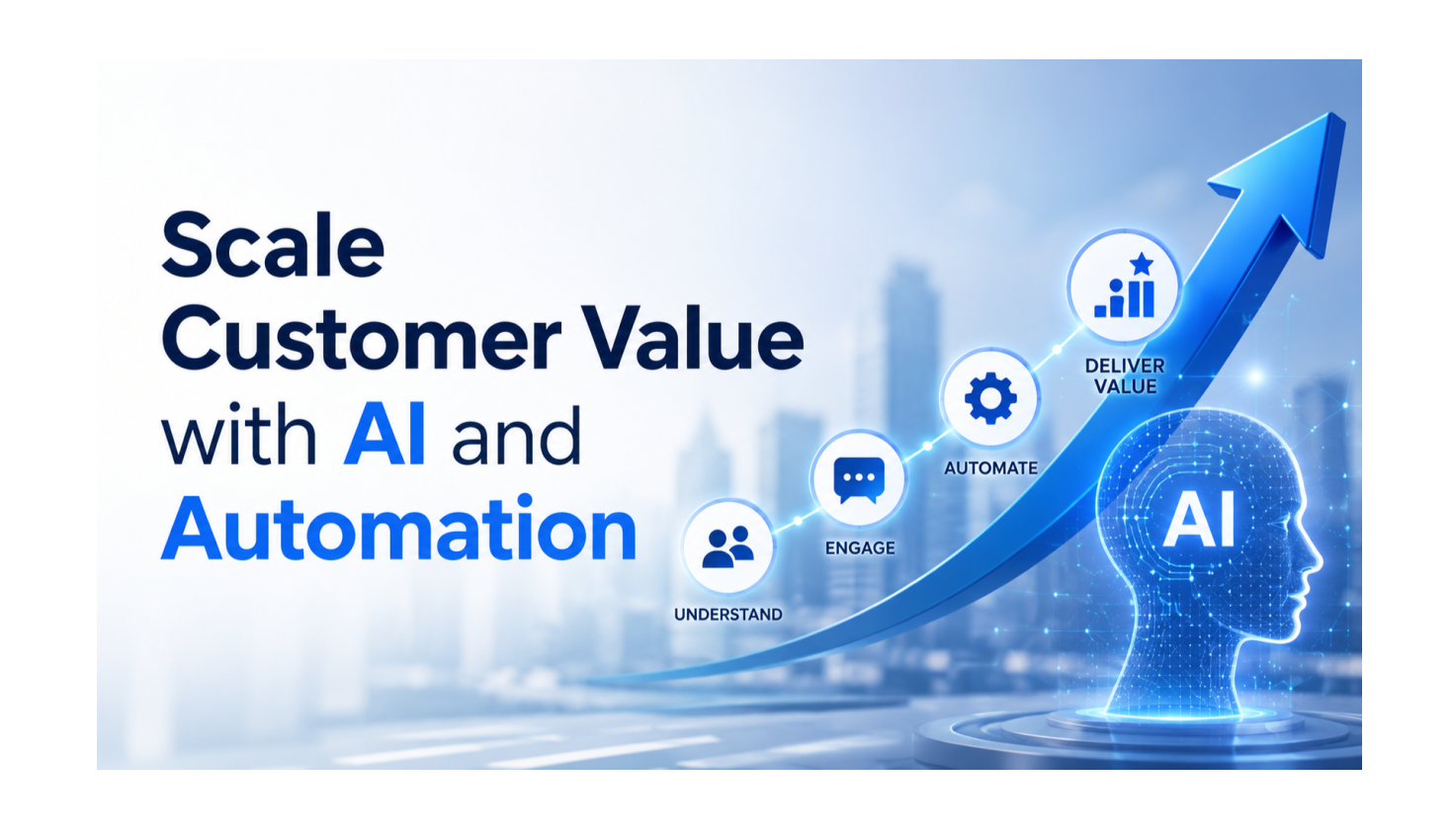
Data is the recurring word that you hear, and the mastery of it becomes a priority for strategy. When we discuss customer data, we inherently think of a CRM (customer relationship management) system. It focuses on managing interactions with customers, analyzing them in the short term, and collecting and organizing their data. Customer value management focuses on maximizing the lifetime value of customers over time. This data is not just tracked but cleaned, analyzed, and segmented with other datasets. Your marketing and sales strategy for customers redevelops from being a short-term pipeline to a long-term flywheel strategy.
A long-term flywheel can be built using the systems and tools at your disposal, even AI and automation. There’s a possibility that you are already using AI and automation tools to decrease customer churn during the sales cycle. Intuit CEO, Sasan Goodarzi, has prioritized implementing AI and machine learning into the TurboTax and QuickBooks products since 2019, so this is not a new idea. However, AI Large Language Models have changed the way we operate. There’s been an economic shift towards their progression, but companies are not sure where it fits in their long-term strategy.
These LLM models can become hyper-personalized, resulting in biased responses. The lack of consequence and direction makes using these models for a company.hazardous. You can say it is like hiring an extra brain to your team. Where are the arms, the legs, the kinetic actions, and the delegated direction? It’s reasonable to question how AI can scale your company and customer value without doing actionable, regulated tasks.
Artificial intelligence LLMs and machine learning tools provide personalized solutions and predicted analysis, respectfully. Automation performs actionable tasks that are dependent on the customer’s position within the sales cycle. Forming a hybrid model that performs hyper-personalized responses for delegated tasks is ideal. Developing it will depend on two crucial steps: cleaning and preparing data and prompt writing. These steps improve the regulation and prediction of your AI and ML tools because you are more direct in your approach while feeding it accurate data.
Implementing AI and ML into your long-term strategy is rather simple. Tools like QuickBooks, Stripe, Shopify, and HubSpot have begun their AI journey years ago and have tools that help clean and prepare the data they store. They also have API options that sync to their system for real-time insights and automation tools that support the customer sales cycle. Prompt writing has become a necessity when implementing LLM models like OpenAI and Claude. Your prompt writing is only as good as your data. They go hand in hand. This is also true for ML models that predict customer behavior and engagement.
When developing your next marketing strategy, consider customer value management, flywheel marketing, AI, and automation. It is vital to record the data you receive during the entire sales cycle, research customer behaviors to note why customers churn, and optimize your tools with automation and AI abilities. With the proper support, you can make an actionable, scalable long-term strategy.