
In an experience-driven market, customer feedback is not just noise. It is one of the most valuable signals your business can act on. But collecting feedback alone is not enough. What separates a good post-purchase experience from the rest is how businesses respond to that feedback in a structured, intentional way.
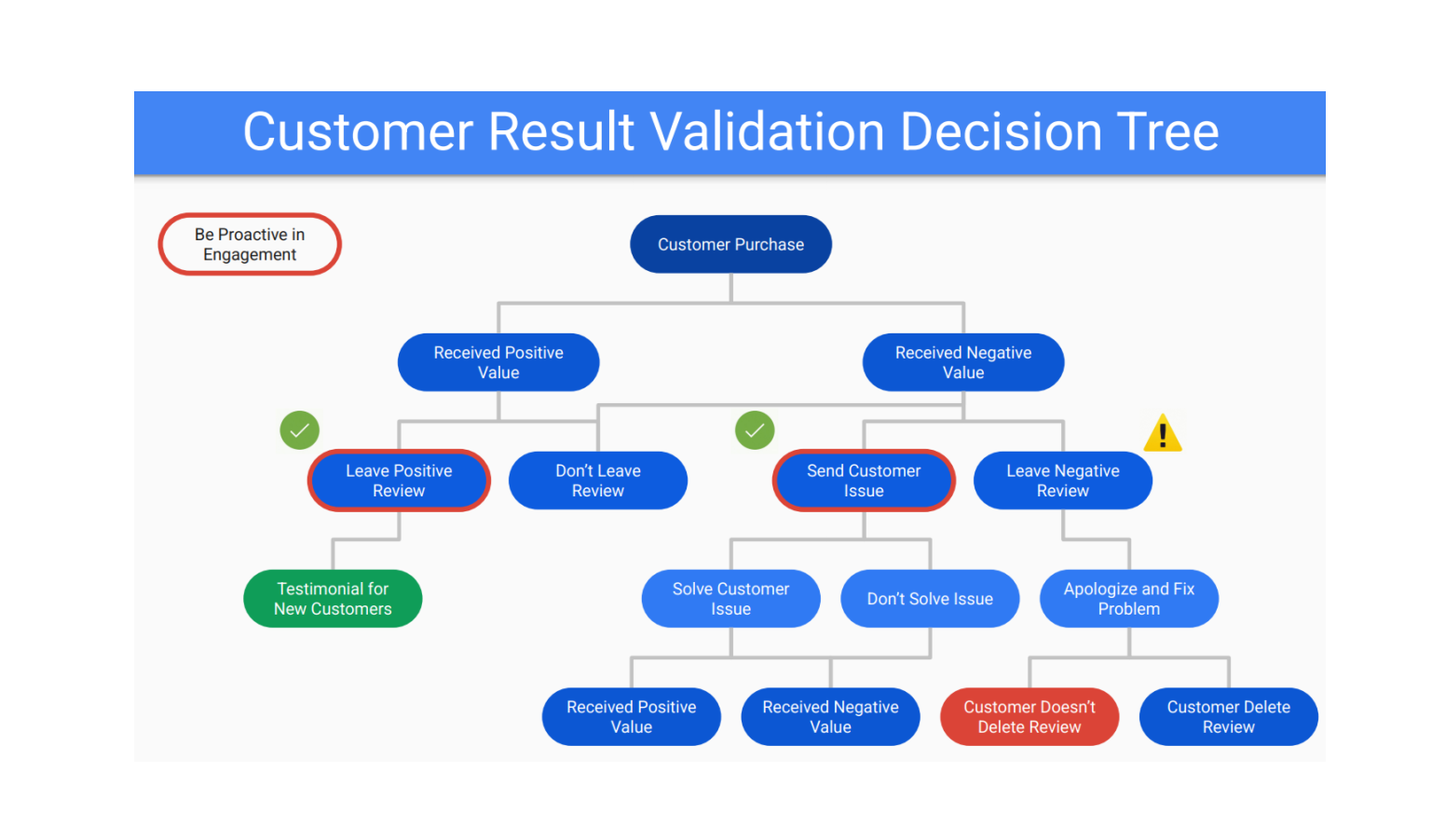
This automated decision tree helps businesses systematically handle customer outcomes, positive or negative, and turn them into growth opportunities, stronger relationships, and better products.
Why You Need a Decision Tree for Customer Feedback
Customer journeys do not end at purchase. Validation begins there. After a purchase, customers evaluate their experience and fall into one of two broad categories:
- They perceive positive value
- They perceive negative value
What you do next determines whether you gain a promoter, lose a customer, or damage your reputation. A decision tree removes guesswork and ensures consistent, effective responses.
Step 1: Customer Purchase → Evaluate Perceived Value
Every path begins with a purchase. From there, customers subconsciously ask:
“Was this worth it?”
Value is measured by time, money, and effort. This value validation can take place immediately or even much longer. All are measured by the customer, and this leads to two branches:
1. Received Positive Value
The customer is satisfied. This could sometimes be 4 or 5 stars or at least 8/10 score. The minimum score is dependent on company goals.
2. Received Negative Value
The customer is disappointed, frustrated, or feels let down. This could be any score below 4 stars or 8/10. There was a clear disconnect between the customer and product.
Step 2A: When Customers Receive Positive Value
This is a moment when you gain momentum, be proactive and champion the customer. There are two options that a customer has after receiving positive value.
Option 1: Encourage a Positive Review ✅
If the experience was strong, proactively guide the customer to:
- Leave a review
- Share a testimonial
- Recommend your product
When customers leave positive reviews, you unlock testimonials that attract new customers.
Option 2: Do Nothing ❌
If you don’t prompt action:
- The customer forgets about you
- You have no valuable advocacy
- You may lose customer loyalty
Satisfied customers are often passive. Without prompting, they won’t act.
Step 2B: When Customers Receive Negative Value
This is a risk zone for businesses, but also your biggest opportunity. The customer is not pleased, and you must assess their reasoning behind their negative value.
Option 1: Do Nothing ❌
If you do the same as before and do nothing:
- The customer is silent to only you about their negative value.
- You don’t have the option to fix the issue
- Competitors may capture attention later
Dissatisfied customers may not leave a bad review, but they will not recommend your business. This negative word of mouth can affect your customer loyalty in places that you can’t access.
Option 2: Customer Raises an Issue ✅
If the customer contacts you instead of leaving a public complaint, that’s actually a win. You now have two paths:
A. Solve the Issue
If you successfully resolve the problem:
- Customer perception shifts
- Trust increases (often higher than before)
- You can recover the relationship
Customers may now receive positive value. This is known as the service recovery paradox—a well-handled issue can create stronger loyalty than a flawless experience. This loops the customer back in the decision tree, and they can either leave a positive review or not one at all.
B. Fail to Solve the Issue
If the issue remains unresolved:
- Frustration increases
- Trust erodes
- The customer may escalate publicly
Failing to solve the issue reinforces the negative value. It’s important to loop the customer back in the decision tree and provide additional customer support.
Option 3: Customer Leaves a Negative Review ❌
If the customer skips contacting you and goes straight to a public review, you’re already behind. Now your response matters even more. Your best action is to apologize and fix the problem. A strong response includes:
- A sincere apology
- A clear path to resolution
- Visible accountability
Step 3: What Happens After a Negative Review?
Of course, this isn’t the best position to be. Customers have several options after you engage with them about their negative review:
Customer Deletes Review (Best Case)
If you resolve the issue effectively:
- The customer may remove the review
- Reputation damage is minimized
- Trust is partially restored
Customer Keeps Review (Worst Case)
If the issue isn’t resolved:
- The negative review remains
- Future customers are influenced
- Brand perception declines
Fraud Intervention
Sometimes negative customer feedback can be given without context. It is customary to work backwards and find the order associated with the negative review. If you cannot find the order associated with the feedback, then it may need to be a flagged response.
There are instances where the negative review cannot be tracked. If this is the case, then it may not be a flagged response.
- The customer account is anonymous
- The audience members have negative feelings about your business ethics.
Be Proactive, Not Reactive
The most important principle in this entire decision tree is to be proactive in engagement. Customer feedback is not just a reflection of your business. It’s a lever you can pull to improve it. There are several options that you have:
- Ask happy customers for reviews before they forget
- Reach out early when issues are likely
- Make it easy to contact support
- Monitor feedback channels continuously
If you’re not actively managing this process, you’re leaving reputation, revenue, and loyalty on the table. Don’t leave outcomes to chance. A structured response system ensures consistency and better results. Positive experiences need activation and happy customers won’t promote you unless you ask. Negative experiences need intervention and an effective resolution can reverse damage. Public perception is shaped by your response. It’s not about the complaint, but how you handle it.